










Hydraulic hoses are an often overlooked part of hydraulic maintenance, but they are essential for the effective and safe operation of the machine. If the hydraulic oil is the lifeblood of the machine, then the hydraulic hose is the artery of the system-containing and guiding the pressure to do its job. But they're just as dangerous if they're not well maintained. Damage to hydraulic hoses is a major cause of accidental injection, which can seriously injure workers. Moreover, you can imagine that if the load drops at an inappropriate time, the hydraulic hose that fails while the machine is running will cause catastrophic consequences. This articleZhongyou Heavy IndustryBring hydraulic hose failure causes and preventive measures.
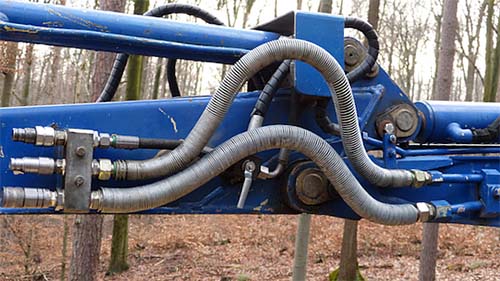
Therefore, in order to ensure the health of the machine and personnel, it is very important to understand the common causes of hydraulic hose failure and understand how to intervene and maintain the hose to keep it in good condition. With this in mind, here are some of the most common causes of hydraulic hose failure and how to prevent them.
1) Pipe corrosion
Pipeline corrosion is characterized by cracks in the inner surface of hydraulic hoses, usually caused by continuous high-speed fluid flowing through the pipeline or fluid contaminated with small particles.
Using a hydraulic hose that is too small may result in higher fluid velocities. Small holes will accelerate fluid flow (think about the increase in water flow from the garden hose when you hold the hose mouth with your thumb). In some cases, bending the hydraulic hose too tightly will produce this effect, and it will also cause the fluid to accelerate, resulting in excessive corrosion at this time.
Fluid contaminated with small particles is another source of corrosion-like sandpaper, flowing over the inner surface of the tube, breaking it down and wearing it away. Ultimately, this will lead to weakness and ultimately failure. This is another reason to change the hydraulic oil filter regularly and always pay attention to the pollution level.
2) Thermal hardening
Excessive heat can cause the hose to become hard and brittle. Heat causes the elastomeric material to break down and lose its flexibility over time. The inner tube will also harden and begin to crack because the plasticizer in the elastomer will decompose or harden at high temperatures.
The shell may appear cracked, dry or blackened. The hose assembly may maintain its shape after being removed from the machine, and if you try to bend the hose, you will see and hear the sound of cracking.
To avoid heat hardening, check the application and replace the hose with a higher heat resistance rating, or take measures to reduce the temperature to which it is exposed. Installing a protective cover or heat shield will help prevent the surrounding heat. In the case of high fluid temperature, please consider installing heat exchangers or adjusting the system design itself.
3) Wear
Wear is a very common enemy of hydraulic hoses, especially in hard working environments where machines perform hundreds of cycles every day. Hoses in contact with other machine surfaces will inevitably suffer from some form of wear. Contact with moving parts and sharp edges will obviously quickly encounter extreme wear, but even subtle vibrations can have an abrasive effect. These can have a significant impact on the integrity of the hose over a period of weeks and months. Eventually, the hose cover will wear away, exposing the reinforcement layer. At this point, the hose is no longer fit for work. Therefore, it is very important to consider the routing of the hose to avoid the most serious potential wear conditions. Where it is unavoidable,
4) Excessive pressure
If the hose is blown out in a very clean manner without signs of wear, it indicates that the pressure on the hose may be greater than the pressure it was designed to withstand. In this case, please review the application, or reduce the working pressure below the maximum pressure rating of the hose, or replace it with a hose with a higher working pressure.
5) Incompatible hydraulic oil
Not all hydraulic fluids are compatible with all hose types. Depending on the application, the hydraulic oil must work in different ways, so the chemical composition of the hydraulic oil type may be very different. Some types of hydraulic oil chemically react with certain types of elastomers-making hydraulic hoses.
Incompatible liquids can cause the inner tube of the hose to deteriorate, swell and delaminate. This is particularly dangerous because it is not always obvious that this is happening from external observation. This means that the hose may suddenly fail without warning.
Never use hydraulic oil without checking hose compatibility. For safety, you must ensure that the fluid is compatible not only with the inner tube, but also with the outer cover, fittings and O-rings. Mixing incompatible liquids is also contraindicated.
6) Exceeding the minimum bending radius
Although hydraulic hoses are flexible, they all have a limit that cannot be exceeded. Exceeding the minimum bending radius may cause buckling, kinking and blockage, which can easily overpressurize the hose and cause spray failure. Even a small bending radius will cause wear points on the machine, where the vibration will be amplified.
To prevent malfunctions, check the length and routing of the hose to ensure that it does not turn more than the minimum bending radius specified by the hose manufacturer.
7) Improper assembly
Improper assembly is another cause of hydraulic hose failure. If the hose connector is not seated deep enough and is not properly crimped and fixed, the higher working pressure will quickly show this. Leakage of fittings or bursting of hoses.
In addition, after cutting the hose to a certain size, the hose must be carefully cleaned and rinsed to prevent contamination by residual grinding debris. The abrasive fragments remaining in the hose can contaminate the hydraulic system and cause small cracks, which can damage the inner tube of the hose assembly. Therefore, the inner tube should be as clean as possible, and after the joint is crimped in place, the end of the hose should be clamped.
8) Exceeding the maximum service life of hydraulic hoses
The hydraulic hose has a long service life and will withstand extremely high pressure during use. As a result, they tend to stretch, fatigue and eventually fail. Therefore, it is important to understand the service life of hydraulic hoses and replace them before reaching the maximum service life of the application.
[Zhongyou Heavy Industry Hydraulic Machine Equipment Advantage]]
Zhongyou Heavy Industry takes fluid pressure forming technology as its core, and its leading products include: internal high pressure forming equipment, plate filling forming equipment, pipe parts hydroforming equipment, water expansion hydroforming equipment, multi-station connected hydraulic deep drawing equipment, four-column hydraulic press equipment, frame hydraulic press equipment, etc. It can design and manufacture special non-standard hydraulic equipment, non-standard oil cylinders, non-standard hydraulic systems and automatic transmission systems according to customer requirements.
The hydraulic press equipment produced by Zhongyou Heavy Industry is widely used in aerospace, nuclear power, petrochemical, auto parts, bicycle parts, hardware products, instrumentation, medical equipment, household appliances, household utensils, sanitary kitchenware and other manufacturing industries.